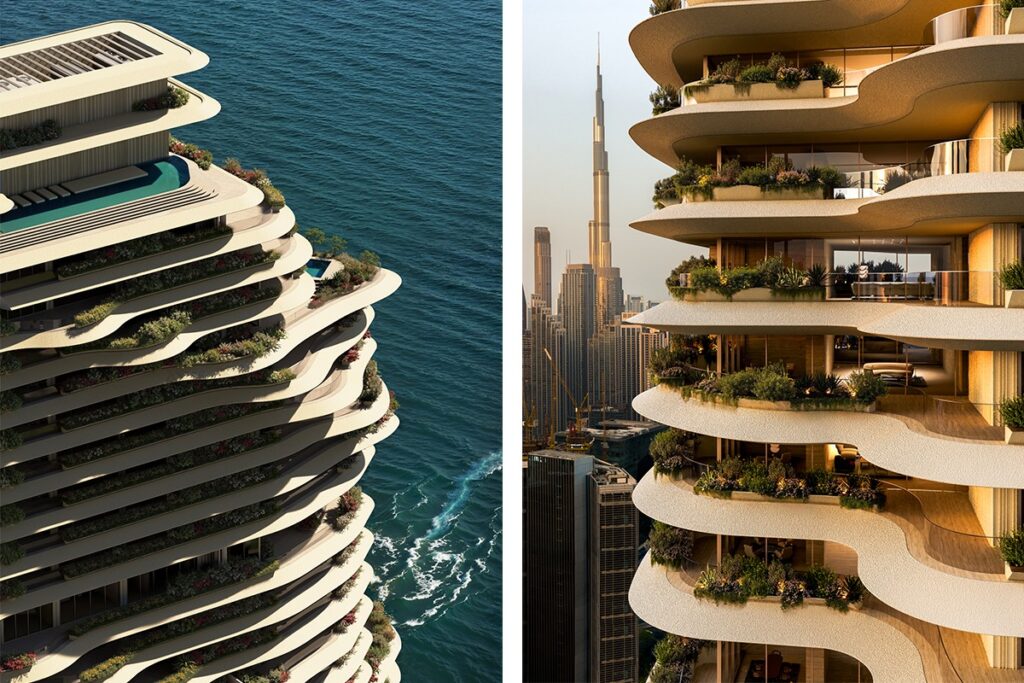
The first thing you notice, arriving at the Dubai Canal site on a bright afternoon, is not the building’s height. It’s the shadows. The sculpted balcony eaves cast shifting lines across the facade that move as you do, as though the building is tracking you. It’s an unusual sensation for a tower still months from completion — the feeling that it’s already alive.
Some buildings seem impressive from miles away, but the inside is cold and lifeless. But others are striking from a distance and feel like works of art from within too. Wedyan, the debut project of the Al Ghurair Collection and Kengo Kuma’s first challenge in the United Arab Emirates, very clearly belongs in the second category.
Set along the Dubai Canal in one of the city’s most sought-after waterfront addresses, Wedyan is a 46-story residential tower that holds 149 homes, two full-floor penthouses and a three-story sky villa. But there’s far more to discuss when looking at what makes this property one of the most compelling prime residences to come to the Dubai market.
Why Kengo Kuma? Why Dubai?
For those familiar with Japanese architecture, the name Kengo Kuma needs no introduction. The architect behind the Japan National Stadium in Tokyo and the China Academy of Art’s Folk Art Museum is celebrated globally for one central idea: Architecture should bridge the gap between humanity and nature. The two should work in harmony, adapting to each other and overcoming challenges in unison.
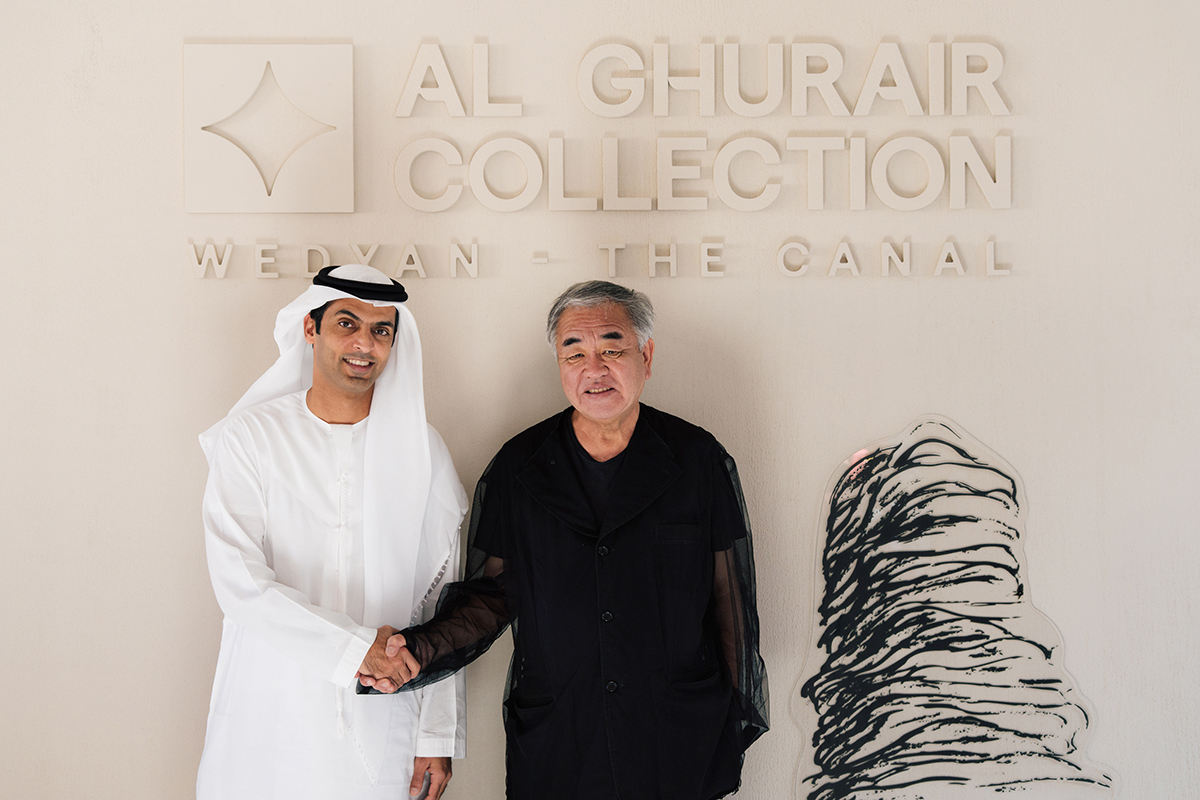
When Al Ghurair, one of the Middle East’s most enduring family business groups, began searching for an architect to lead its new super-prime residential portfolio, Kuma was the answer. Sultan Al Ghurair, CEO of Al Ghurair Development, put it simply: The goal was to create buildings that simply do not exist elsewhere. Kuma’s commitment to originality and obsession with material detail made the partnership an easy one.
Kuma’s own framing of the project comes with his usual directness. “Wedyan is a dialogue between Japanese aesthetics and the context of Dubai,” he has said. The design is inspired by the flowing movement of sand dunes and the play of light across the local desert terrain. But practicality is everywhere: The layered facade, with its sculpted balcony eaves and organic contours, is not a decorative choice — it filters sunlight, minimizes heat gain and frames views of the Dubai Canal the way a carefully designed engawa frames a Japanese garden.
A Space Shaped by Permeability and Light
Kuma’s spatial philosophy is based on three ideals: permeability, tactility and the relationship between light and shadow. At Wedyan, these principles can be seen at every level of the building.
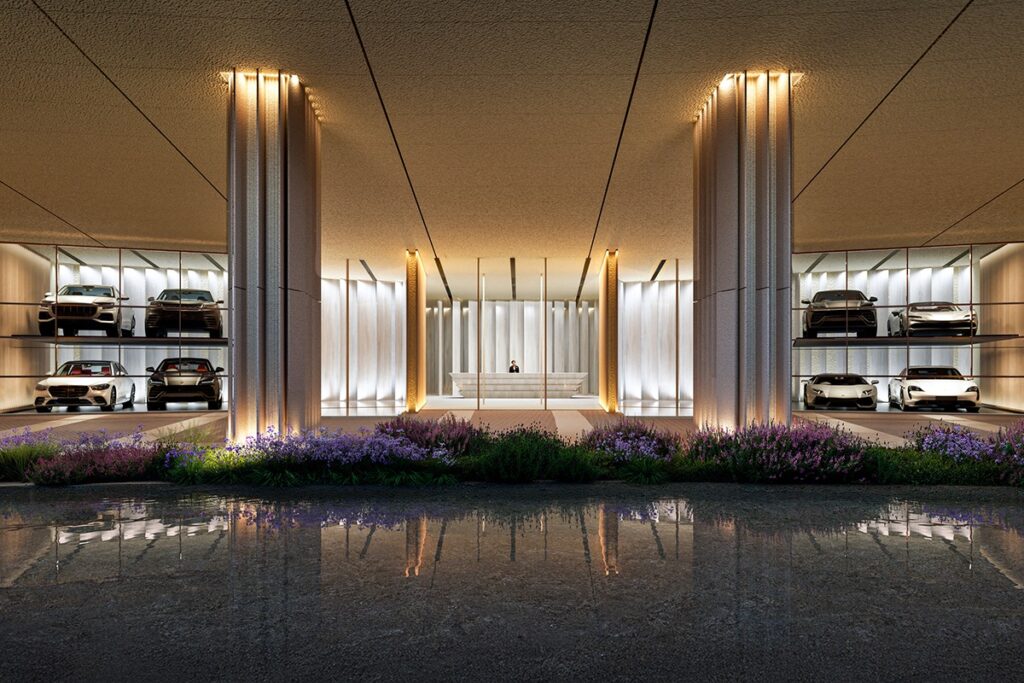
Arrival begins at The Oasis: a below-ground entry experience lined with verdant greenery and flowing water that slowly draws residents away from the noise of the city. From there, the different living spaces unfold naturally, with Levels 2 and 3 housing The Shore and The Valley, dedicated to active living, family time and social hosting. Level 17 contains The Cave, a curated wellness space. The Mountain on the 36th floor is reserved for private meetings and quiet retreat.
In total, Wedyan offers more than 65,000 square feet of amenity space, including unique touches such as private treatment rooms where residents may bring their own therapists, a reformer Pilates studio, a podcast room and boxing facilities. Filtered air and water systems run throughout the building.
What distinguishes Wedyan from other ultra-luxury developments, however, is not the number of amenities but the carefully designed atmosphere. Kuma has written about what he calls SaraSara: an idea in which air, light and shadow move through a building rather than being blocked by it. At Wedyan, the sculptural balconies create shifting shadows across the facade throughout the day, so that residents experience the passage of time from within their homes. It is the kind of detail that reveals itself slowly, over months of living, rather than in a single viewing appointment.
The Residences: Three, Four and Five Bedrooms Designed for How People Actually Live
The residence mix, three-, four- and five-bedroom homes, alongside the penthouses and sky villa, reflects a clear understanding of the residents Wedyan has in mind. These are not pied-a-terre investments. They are permanent homes for internationally mobile families who have chosen Dubai.
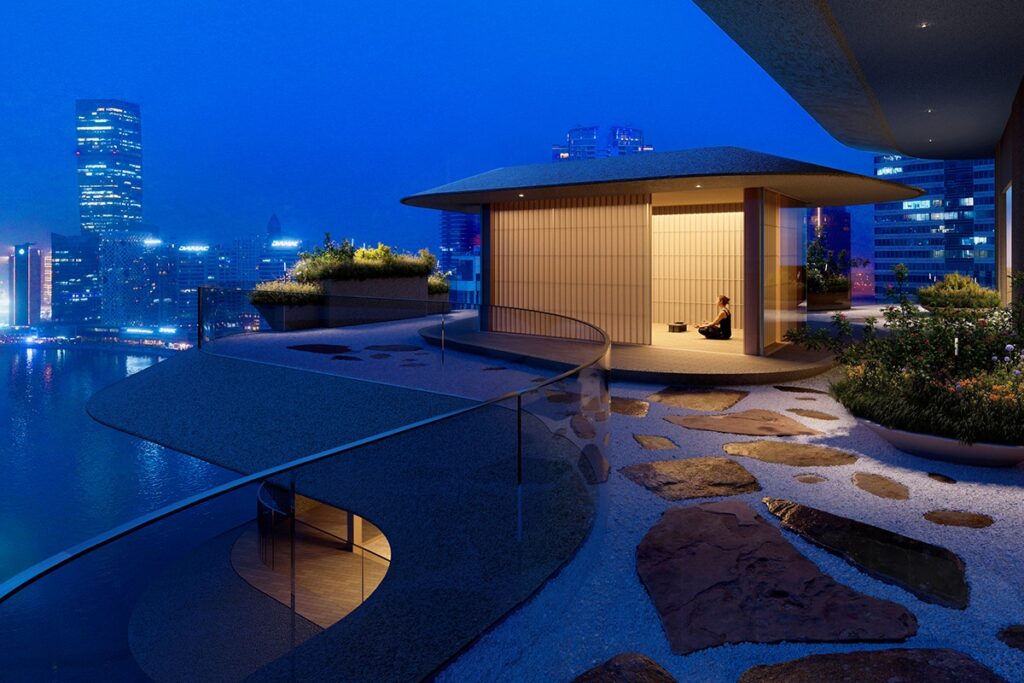
Several features in the homes highlight this. Each home includes a secondary kitchen with its own access, which is essential for families to entertain guests. Specialized glazing on the windows protects artwork collections from UV damage. Selected residences include standalone pavilions on their terraces, designed in the philosophy of Japanese teahouses: light, open structures where shadow and natural textures replace decorations. These private spaces create the perfect environment for meditation, relaxation or even a serene private meal with loved ones.
The landscaping, designed alongside Gustafson Porter + Bowman, brings greenery to every level of the building. Deep-planted terraces and shaded promenades create what Kuma describes as gardens in the sky. The planting palette was selected specifically for Dubai’s climate, with plants such as aloe vera, Bismarck palm and trailing ice plants, while at ground level, a landscaped promenade connects the building to Dubai Canal itself.
The Market Moment
Dubai’s ultra-prime residential market has moved quickly. In the first half of 2025, the city recorded 431 billion dirhams in property transactions. This is a 25% increase year over year, with sales of homes above 10 million dirhams growing more than fourfold in recent years. The families driving this are not transient. They are choosing Dubai as a permanent base, and they are choosing it with the same scrutiny they would apply to selecting property in London, Tokyo or New York.
Wedyan slots perfectly into the niche these families are seeking. Its location on the Dubai Canal puts residents within minutes of Business Bay, Jumeirah, Downtown Dubai and within 20 minutes of Dubai International Airport.
Architecture as a Source of Calm
Kuma has said that buildings most likely to endure are those that stop chasing trends and instead respond to their landscape, their climate and their specific quality of light. It sounds like an obvious point until you spend time in buildings that ignored it.
For a Japanese audience attuned to the idea that refinement announces itself quietly, through proportion and material care, Wedyan will feel recognizable. Not because Kuma has borrowed Japanese aesthetics for effect, but because the values are held genuinely by someone who has spent decades proving that restraint isn’t a limitation. It is, when handled well, the most intense form of luxury available.
The shadows on the facade don’t let you forget that.